

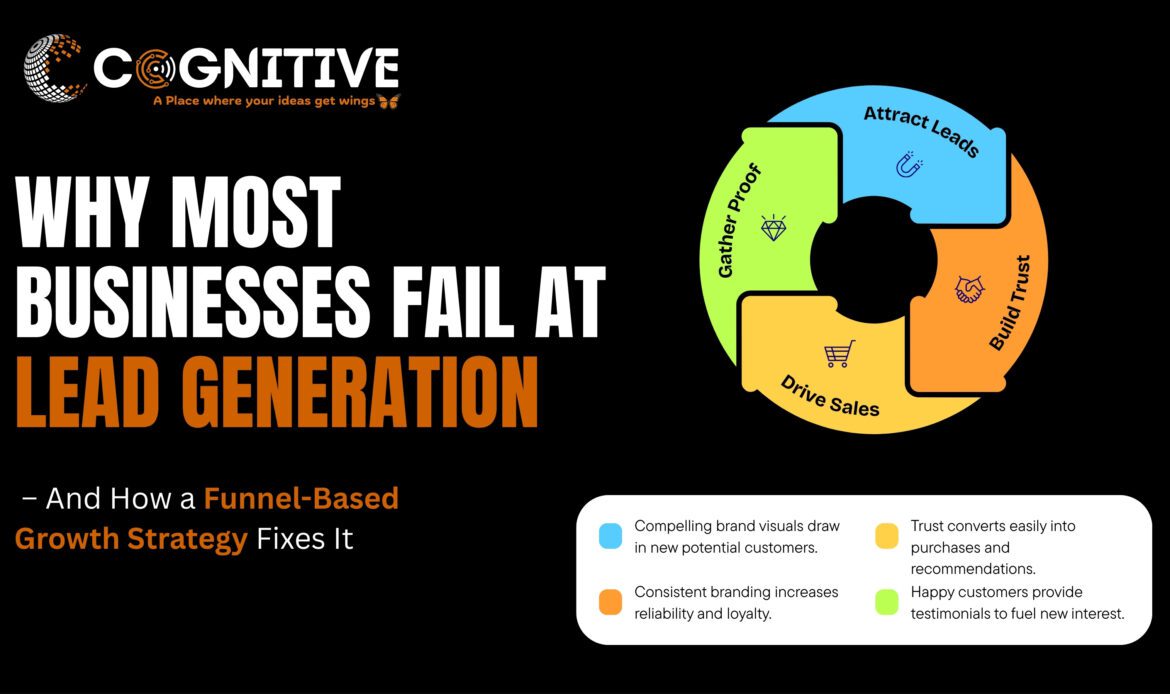
Why Most Businesses Fail at Lead Generation – And How a Funnel-Based Growth Strategy Fixes It
In today’s digital-first market, businesses are spending more on marketing than ever before—yet most still struggle with poor-quality leads, low conversions, and unpredictable growth.
Clicks are coming in. Impressions look healthy. Ads are running.
But revenue growth? Often inconsistent.
The real problem isn’t visibility.
The problem is how visibility is converted into business outcomes.
At Cognitive Digital Marketing Services, we see one common issue across industries:
👉 Businesses focus on channels, not customer journeys.
This blog breaks down why traditional lead generation fails and explains how a structured, funnel-based growth strategy creates consistent, high-quality leads.
The Biggest Myth in Digital Marketing: “More Leads = More Growth”
Many businesses equate growth with:
More ads
More traffic
More enquiries
But in reality:
Not all leads are equal
High volume often means low intent
Sales teams burn out chasing unqualified prospects
A lead that is not ready, not informed, or not aligned with your offering is not an asset—it’s a cost.
True growth comes from intent-driven leads, not random enquiries.
Why Traditional Lead Generation Models Fail
1. They Ignore Buyer Intent
Most campaigns target broad keywords and interests:
“digital marketing”
“best hospital”
“top coaching centre”
These users are often researching, not deciding.
Without intent segmentation, you attract:
Price shoppers
Information seekers
Non-decision makers
Which leads to low conversion rates and poor ROI.
2. No Funnel = No Direction
Many businesses run ads that directly push:
“Contact Us”
“Call Now”
“Book Appointment”
But users ask:
Why should I trust you?
How are you different?
Is this right for me?
Without answering these questions before asking for action, leads drop off.
3. Content Exists, But Strategy Doesn’t
Blogs, reels, and ads are often created in isolation:
No alignment with buyer stage
No internal linking
No conversion pathway
Content without structure becomes noise, not authority.
4. SEO Focuses on Rankings, Not Revenue
Ranking for keywords is not the goal.
Ranking for commercial and transactional intent is.
Without mapping keywords to funnel stages, SEO becomes a traffic game—not a growth engine.
The Funnel-Based Growth Strategy: How High-Quality Leads Are Actually Created
A funnel-based strategy aligns user intent, content, and conversion paths into one unified system.
Stage 1: Awareness (Problem Recognition)
This is where users realize:
“I have a problem”
“I need information”
What works here:
Educational blogs
Awareness reels
Informational SEO content
Goal: Build trust and authority
Not: Sell immediately
Stage 2: Consideration (Solution Comparison)
Users now ask:
What are my options?
Who is best for this?
What should I look for?
What works here:
Comparison content
Service explainers
Case studies
Solution-based blogs
Goal: Position your brand as the best-fit solution
Stage 3: Conversion (Decision Making)
Only now are users ready to:
Call
Book
Enquire
What works here:
Landing pages
Testimonials
Trust signals
Clear CTAs
Goal: Remove friction and close decisively
Stage 4: Retention & Authority
Most businesses stop after conversion.
Smart brands build:
Repeat business
Referrals
Brand evangelists
What works here:
Email nurturing
Educational follow-ups
Community building
How Cognitive Executes Funnel-Based Lead Generation
At Cognitive, we don’t “run campaigns.”
We architect growth systems.
1. Intent Mapping Before Marketing
Every project starts with:
User intent analysis
Keyword intent clustering
Funnel stage mapping
This ensures right message → right audience → right time.
2. SEO That Targets Business Outcomes
Our SEO focuses on:
High-intent keywords
Local + service-based search
Topic authority, not keyword stuffing
We build content ecosystems, not isolated pages.
3. Content That Moves Users Forward
Every piece of content has:
A purpose
A funnel stage
A conversion path
Blogs educate.
Landing pages convert.
Remarketing nurtures.
4. Paid Ads That Filter, Not Flood
Instead of chasing volume, we:
Qualify users before enquiry
Use messaging layers
Align ad copy with funnel stage
Result: Fewer leads, higher conversions, better ROI.
The Result: Predictable, Scalable Growth
Businesses using a funnel-based strategy experience:
Higher lead quality
Shorter sales cycles
Better marketing ROI
Clear growth visibility
Most importantly, marketing becomes measurable and sustainable, not guesswork.
Final Thought: Growth Is a System, Not a Tactic
If your business relies on:
Random ads
One-off campaigns
“Let’s try this” strategies
Growth will always feel unstable.But when marketing is built as a structured funnel, growth becomes intentional, repeatable, and scalable.That’s the difference between doing digital marketing and engineering growth.
About Cognitive Digital Marketing Services
Cognitive is a strategy-first digital marketing firm focused on SEO-led growth, funnel-based lead generation, and performance-driven content systems for brands that want long-term dominance—not short-term noise.